


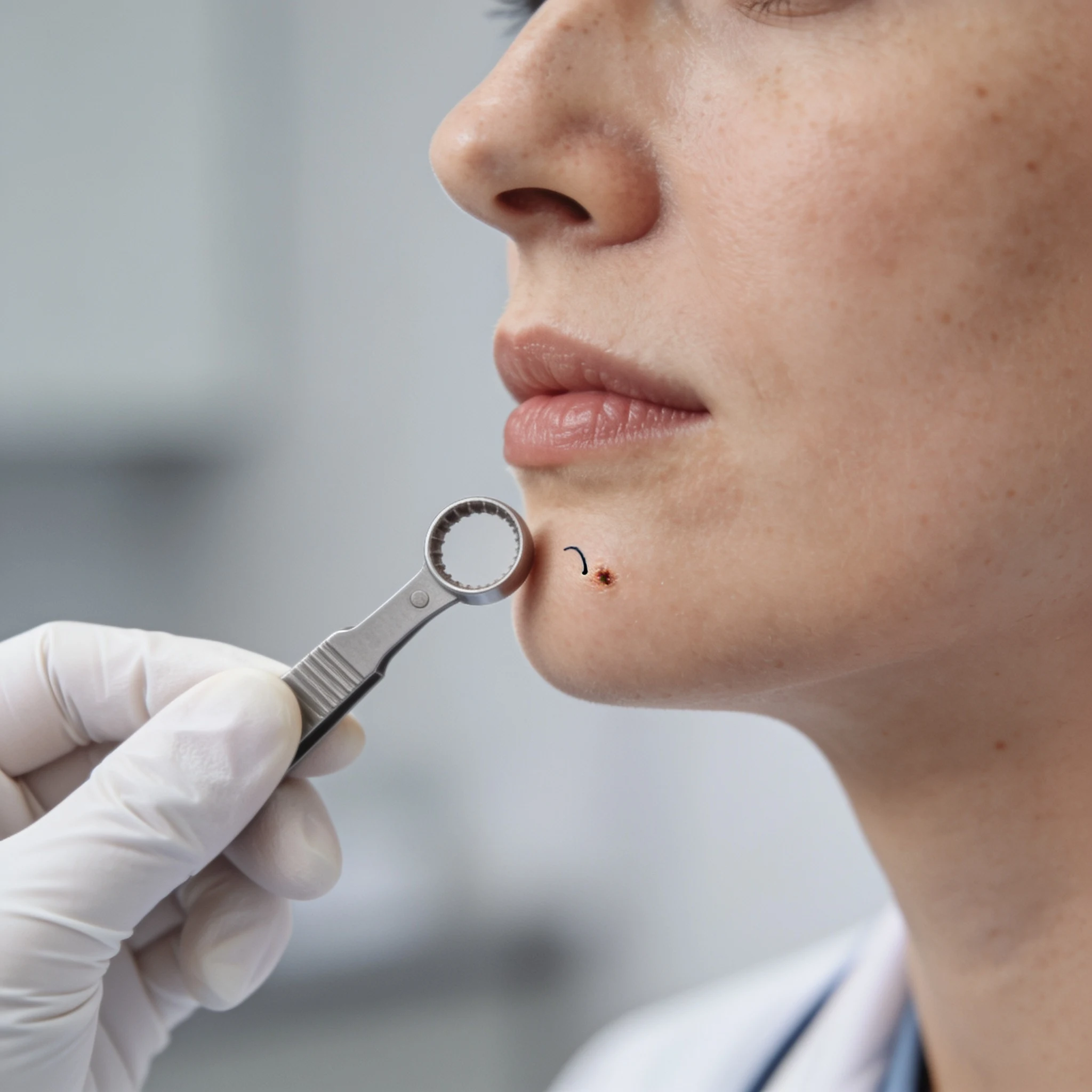
Punch excision is a quick in-office surgery where a dermatologist cuts out a deep ice pick scar with a small circular punch tool, then closes the resulting hole with a stitch. The pit disappears; a thin, much less visible line takes its place. It targets one specific scar shape. Narrow, deep ice pick scars sit too far down in the skin for lasers, peels, or microneedling to reach on their own.
What Punch Excision Is and Why Ice Pick Scars Need It
Punch excision physically removes the scar tissue. Other methods try to resurface or plump it from above. Ice pick scars are narrow, V-shaped depressions that dig into the deep dermis or even the fat layer underneath. They’re the most common type of atrophic acne scar, making up an estimated 60-70% of them, according to DermNet NZ. That depth is exactly why surface treatments struggle with them. A laser or peel can smooth the surrounding skin without filling a hole that descends straight down. The tool is the same kind of circular punch used for skin biopsies, sized to match the scar, generally somewhere between 1mm and 12mm across. The dermatologist presses it through the full depth, cutting a clean, round column of tissue free from surrounding skin. What remains is a small, deliberate wound the doctor controls precisely. You’re replacing the ice pick scar with a scar you’d rather have. This is removing the scar, not smoothing it. Understanding that upfront sets realistic expectations before anyone books a consultation for the procedure. Skin doesn’t come out unmarked. It comes out with a smaller mark that fades and flattens over the following months.
What Happens During the Procedure, Step by Step
The area is numbed first, usually with a local anesthetic like lidocaine, injected directly around the scar. The injection itself is typically the most uncomfortable part of the whole visit, felt as a brief sting. Everything after that is mild soreness at the treatment site for a few days.
Once the skin is numb, the process runs in a short, predictable sequence:
- The dermatologist selects a punch tool matched to the scar’s diameter.
- The punch is pressed straight down through the scar, cutting a full-thickness column of tissue free.
- The scarred plug is lifted out and discarded.
- The remaining hole is closed with fine sutures, or occasionally left to heal on its own instead, by what’s called secondary intention.
- A small dressing goes over the site before the patient leaves.
A single scar takes only a few minutes, so a doctor’s office commonly works through five to ten scars in one sitting. That pace matters for anyone with several ice pick scars scattered across the cheeks, since it turns what sounds like a major operation into one office visit. This is a one-time procedure per scar; once excised and closed, that pit does not recur on its own. A dermatologist or dermatologic surgeon performs it in a clinical setting, per Medical News Today’s overview of ice pick scar treatments. It stays outside the scope of general aestheticians and any at-home treatment.
Punch Excision vs. Punch Elevation vs. Punch Grafting
All three techniques begin with a circular punch tool. What differs is how the tissue is handled afterward, based on scar appearance and depth. Narrow ice pick scars call for straight excision. Flatter, sharper-edged boxcar scars work better with elevation. Larger or deeper craters often require a graft to fill the space after excision. Each choice depends on what the individual scar looks like under exam lights.
| Technique | What happens to the scar tissue | Best scar type | Downtime | Visible end result |
|---|---|---|---|---|
| Punch excision | Cut out with a punch tool (roughly 1-12mm), then closed with fine sutures | Narrow, deep ice pick scars | Days of soreness while sutures hold the wound | Thin linear scar in place of the pit |
| Punch elevation | The base of the scar is freed and lifted level with the surrounding skin | Sharp-edged boxcar scars | Comparable short recovery; the disc of skin stays in place | Skin sits flush with surrounding area |
| Punch grafting | Excised, then the hole is filled with a skin graft from behind the ear | Larger or deeper scars | Two sites healing at once: the scar site and donor site | A round patch fills the hole; possible color or texture variation |
Excision works best for a narrow pit that can close on its own. Elevation works better for a wider, shallow boxcar scar where the surrounding skin doesn’t need to be pulled together at all, just released and repositioned. Grafting handles situations where the hole left behind is too large for simple stitched closure without pulling or puckering the surrounding skin. A dermatologist decides between the three by measuring the scar’s width and depth during an in-person exam.
Punch Excision vs. Subcision: Why the Tool Changes With the Scar Shape
Subcision and punch excision address different scar structures based on depth and shape. Subcision uses a needle inserted under the skin to sweep back and forth, cutting the fibrous bands that tether a rolling scar down from below. The skin surface stays intact, so subcision has minimal downtime and carries little risk of adding a new visible mark.
That makes subcision the better fit for a rolling scar, where the problem is a band pulling healthy-looking skin down into a shallow dip. It does nothing for an ice pick scar, because there’s no band to release. The pit itself is the wound; nothing under the skin is pulling it down.
Punch excision cuts tissue from above and removes the entire scar. It requires sutures and a longer healing period than subcision. A pit descending straight down through the dermis needs removal at the source. Subcision frees a scar that’s anchored. Punch excision takes out a scar that’s simply too deep to smooth or release.
One works from below; the other from above. Most acne scarring includes more than one scar shape on the same face. That’s why dermatologists generally plan treatment scar-by-scar, matching each pit or dip to its own technique.
Recovery Timeline and Aftercare
Recovery from punch excision follows a predictable path. Most healing occurs in the first two weeks. Sutures come out 5 to 10 days after the procedure, typically around 7 days on the face. The area continues flattening. Full wound maturation takes about three months, with collagen remodeling refining the scar for several additional months.
- First 24 hours: keep the treated area completely dry.
- Daily until sutures come out: clean the wound and change the bandage as directed.
- First week or more: avoid direct sun exposure on the healing site.
- First two weeks: some swelling and bruising is normal and expected.
- Around 3 months: the wound reaches full maturation, though collagen remodeling continues for several months.
Most patients resume normal daily activity within a few days. Daily cleaning and a fresh bandage protect the wound while the sutures hold it closed, and keeping the site out of direct sun helps the eventual scar line fade evenly. The scar line continues settling and fading for months after suture removal, well past the point most patients stop thinking about it day to day.
Risks and Who Is (and Isn’t) a Good Candidate
A good candidate has an indented, atrophic scar at least about a millimeter wide. Punch techniques as a group work on that kind of pit. Raised scarring needs a different treatment path entirely.
Like any minor surgery, punch excision carries risks. Bleeding, infection, hyperpigmentation, and rarely a replacement scar that becomes wider or more visible can occur. A dermatologist should walk through these risks beforehand. Punch grafting adds a further risk, since the graft itself can differ in color or texture from the surrounding skin once it heals, a tradeoff the American Society for Dermatologic Surgery also flags for graft-based repair.
Punch excision has clear limits. Raised scars like hypertrophic or keloid scars sit above the skin surface; this procedure targets pits. Brown or red discoloration requires separate pigment treatment, since punch excision only removes the physical depression.
None of this replaces professional medical advice or an in-person visit with a dermatologist, who can examine the actual scars and say whether excision, elevation, grafting, or something else entirely fits the case.
What Punch Excision Costs
The cost is per scar. A single visit commonly treats five to ten scars, so the bill scales with the number treated. Insurance does not cover the procedure, since it is classified as cosmetic. Pricing varies by provider, location, and scar complexity, and no single national figure applies everywhere. One Southern California clinic charges roughly $200 to $700 per scar as an example; patients with multiple scars multiply this figure accordingly. Getting an exact number means a consultation, since the quote depends on how many scars need treatment and how each one looks under exam lights.
What Usually Comes Next
Weeks to months after the excision site heals, many patients follow up with a complementary resurfacing treatment. Laser resurfacing, a chemical peel, or TCA CROSS can blend the remaining linear scar further into the surrounding skin. Punch excision handles the depth. Resurfacing handles the blending.
That two-step approach reflects how dermatologists generally think about scar work. They match the tool to the specific defect, then layer a second tool onto what the first one leaves behind. With grafting, a round patch fills the original hole, still visible up close but far less noticeable than the crater it replaced. Outcomes depend on scar depth, skin type, and how precisely the technique matches the scar in front of the doctor.
Punch excision is one tool in a broader kit for addressing acne scarring long-term. It sits alongside options ranging from topical tretinoin for milder texture concerns to surgical approaches for the deepest pits. Ice pick scars specifically call for physical removal, since a laser or peel cannot fill a hole that runs straight down into the dermis. Keloid or hypertrophic scars need a different approach aimed at raised tissue.
FAQ
Does punch excision hurt? The procedure uses local anesthetic. The numbing injection is usually the most uncomfortable moment, a brief sting. After that wears off, soreness is mild.
How long does punch excision take to heal? Sutures come out 5 to 10 days later, typically around 7 days on the face. Swelling and bruising may continue through the second week. Full maturation takes about 3 months, with refinement continuing for several more months.
How much does punch excision cost? Cost is per scar and not covered by insurance (classified as cosmetic). One Southern California clinic charges roughly $200 to $700 per scar; pricing varies by provider, location, and scar complexity.
What’s the difference between punch excision and punch elevation? Punch excision removes the scar and closes the hole with sutures. Punch elevation frees the base and lifts it level with surrounding skin. Elevation suits boxcar scars; excision suits ice pick scars.
Is punch excision the same as subcision? No. Subcision uses a needle to release tethering bands without breaking the surface, so downtime is minimal. Punch excision removes tissue directly through an opening. For deep ice pick scars, removal is what’s needed.
Who performs punch excision? A dermatologist or dermatologic surgeon performs punch excision in a clinical setting. It isn’t offered as a DIY treatment or by a general aesthetician.
Is punch excision permanent? Yes. The scar tissue is physically removed, so the original pit does not come back. What remains is the thin linear scar left by the sutures, which continues to fade over several months as the wound matures.
How soon after punch excision can other scar treatments start? The excision site needs to fully heal first, sutures out and the wound matured, before layering on anything else. That lines up with the recovery timeline above, roughly a few months, though it depends on how the individual wound is healing.

Veronica Flores
Introducing Veronica Flores, a medical aesthetician and skincare specialist with a particular focus on acne and acne scarring treatments. Veronica's own journey with problematic skin has fueled her passion for helping others overcome their challenges and achieve the clear, radiant skin they desire.After earning her Bachelor of Science in Biology from the University of Florida, Veronica pursued a career in the skincare industry by becoming a certified medical aesthetician. She has since worked alongside top dermatologists and plastic surgeons, gaining valuable experience in both medical and holistic approaches to skincare.Veronica is dedicated to staying at the forefront of skincare advancements and frequently attends seminars and trainings to expand her knowledge. She is a firm believer in the power of personalized treatments and a well-rounded approach to skin health, which includes proper nutrition, exercise, and stress management.In her free time, Veronica enjoys sharing her skincare tips on her personal blog, experimenting with DIY beauty recipes, and spending time with her family and friends. By contributing her expertise to acne-scarring.info, Veronica aims to help readers find effective solutions for their skin concerns and build confidence in their appearance.
View all posts by Veronica Flores →